
AI
Autonomous agents
Design an artificial agent capable of perception, decision-making and real-time behaviour inside a networked Unity FPS environment.
ResearchBuild an autonomous bot for a Unity first-person shooter that behaves so naturally that human players cannot tell it apart from another person.
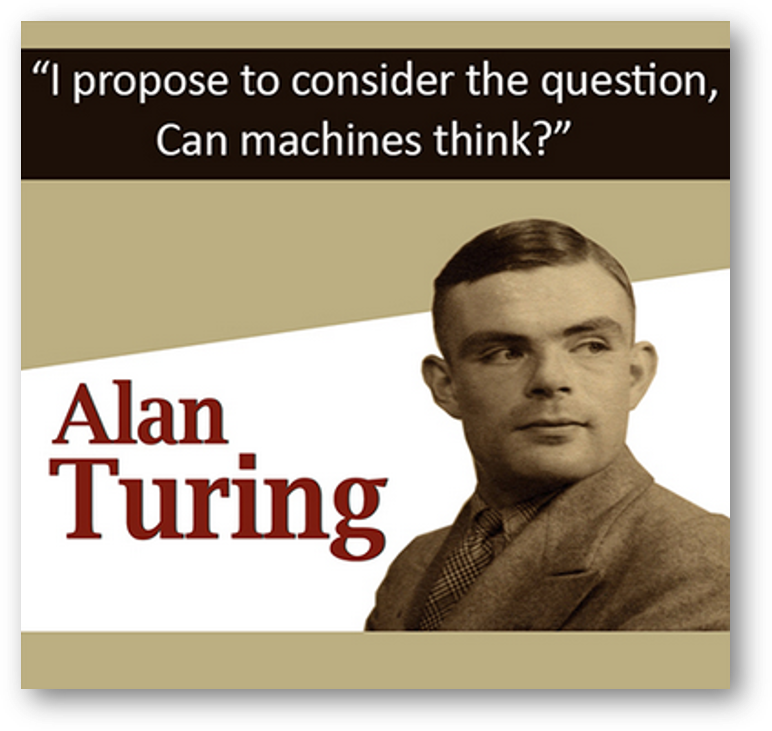
BotPrize changes the target of game-AI evaluation: the goal is not simply to win, but to behave in a way that is indistinguishable from a human player.
Design an artificial agent capable of perception, decision-making and real-time behaviour inside a networked Unity FPS environment.
ResearchHuman judges play alongside bots and decide which opponents are people and which are controlled by an artificial agent.
Human-centred AIThe modern Unity-based environment lowers the entry barrier and supports learning-based, hybrid and cognitively inspired approaches.
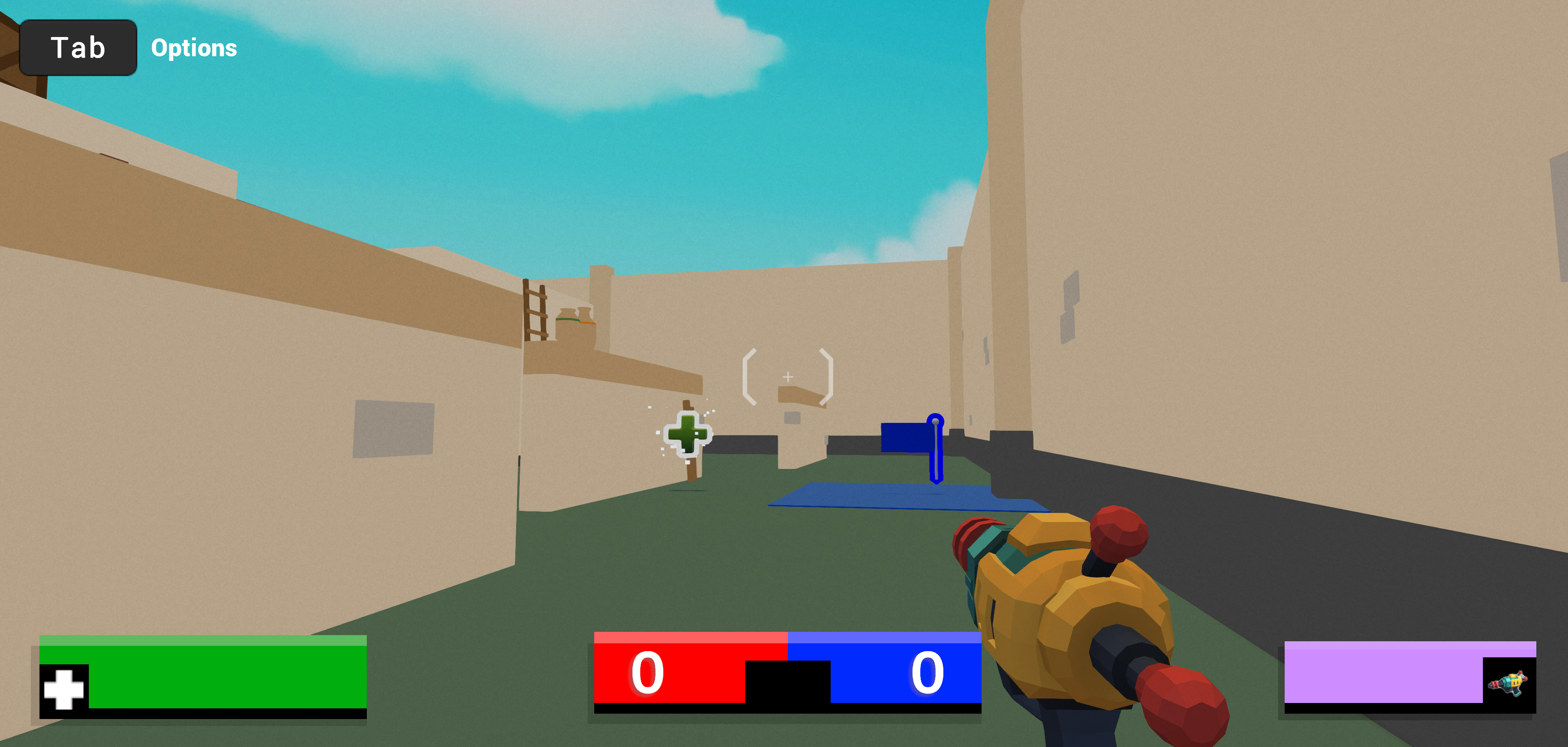
AccessibleThe 2026 edition reimplements the concept using the Unity FPS Microgame, modified for networked multiplayer and AI-agent integration.
BotPrize revisits the question associated with Alan Turing: can an artificial agent behave in a way that is indistinguishable from a human player in a fast-paced FPS?
Unlike the original closed, legacy environment, Unity provides a modern, extensible development environment and room for a broad range of AI techniques.
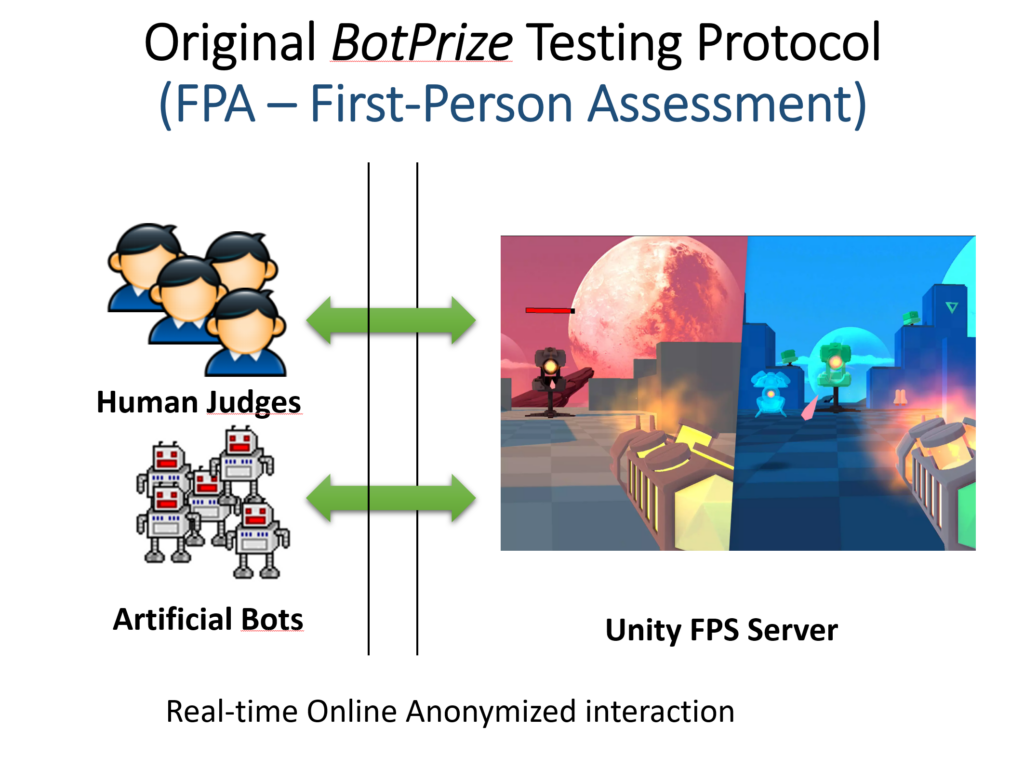
The submitted agents are evaluated through two complementary phases: direct first-person judgement and anonymized third-person video judgement.
On a game server, a human player is paired with each submitted bot. Judges play and vote on whether observed players are human or artificial.
Participants record and share anonymized gameplay videos featuring bots and humans. Judges then vote on which players are human.
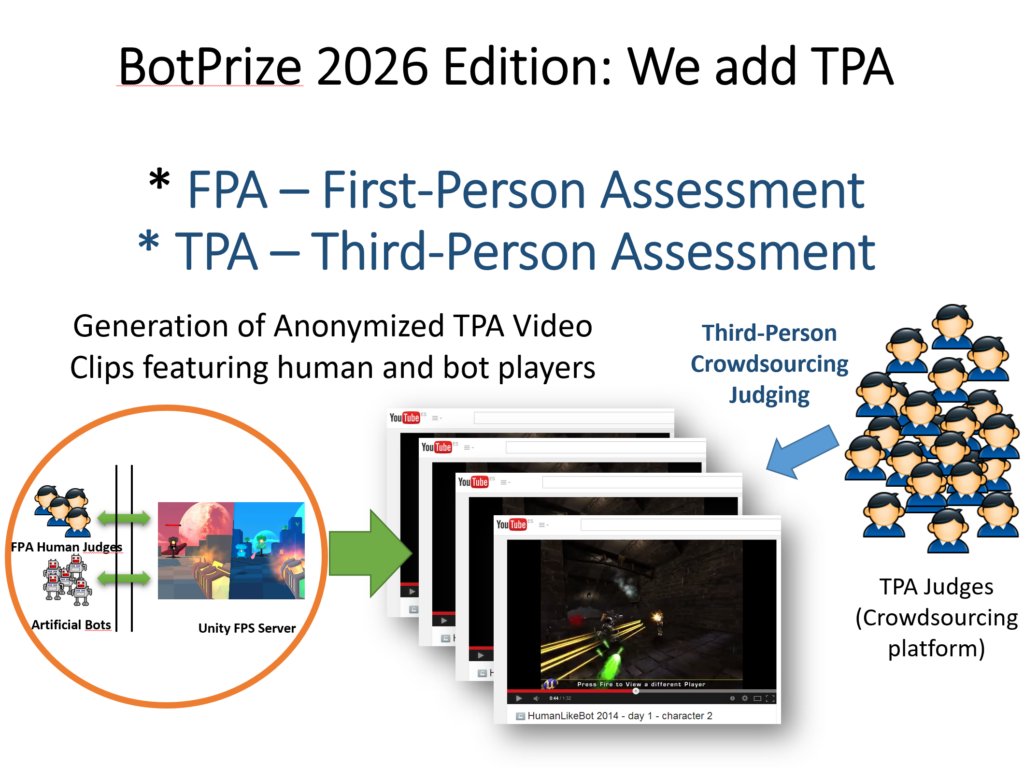
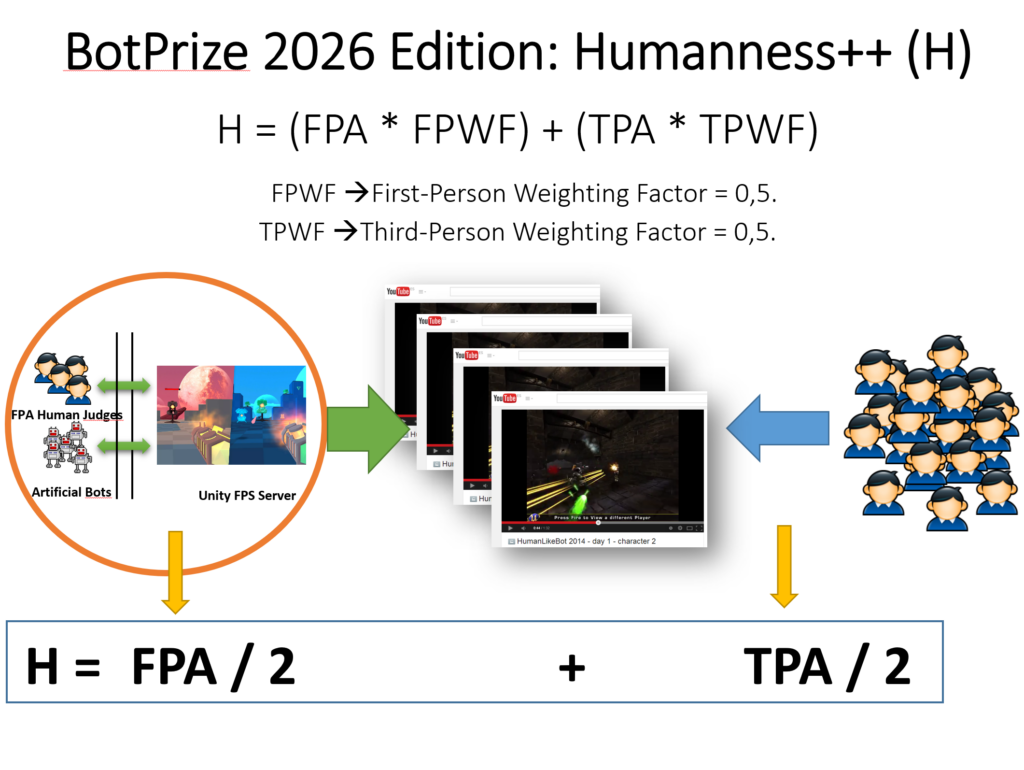
For the 2026 edition, the published weighting factors are FPWF = 0.5 and TPWF = 0.5, giving equal weight to the two assessment perspectives.
The competition modernizes the original BotPrize concept first presented at IEEE CIG 2014 and connects it with current research on human-likeness and beyond-score evaluation.
Final date published on the competition site for registration.
Deadline for submitting the proposed AI approach.
Competition evaluation of submitted individuals/agents.
Results are announced during the CoG 2026 competition session; finalists are announced in advance.
The competition is positioned as both a research benchmark and an educational environment for Game AI and AI in Games.
Encourages alternative evaluation paradigms where the quality of an agent includes how human its behaviour appears.
A reusable Unity-based environment can support controlled comparisons and repeated experimentation.
Accessible enough for university courses and project-based learning around Game AI and AI in Games.
Humanness score (H) achieved by each participant, calculated as H = (FPA × FPWF) + (TPA × TPWF).
| Rank | Participant | Team / Affiliation | FPA | TPA | H (Humanness) | Type | Verdict |
|---|---|---|---|---|---|---|---|
| 01 | Player 4 | Universitat Politècnica de València | 100% | 77% | 88% | Human | Passed |
| 02 | Player1 | Universidad de Málaga | 100% | 44% | 72% | Human | Passed |
| 03 | PepeBot | Universidad de Málaga | 50% | 35% | 42% | Bot | Not passed |
| 04 | ADANN | Universitat Politècnica de València | 7% | 21% | 14% | Bot | Not passed |
Get the Unity FPS project and start experimenting with your approach.
BotPrize 2026 is organized by researchers at the Universitat Politècnica de València.
Browse previous BotPrize editions, their specific rules and the historical competition results.
See how bots and their humanness scores have evolved edition after edition, from the original BotPrize to today.